
DAILY – Griffith Observatory
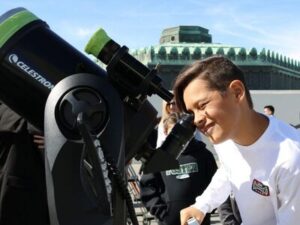
OBSERVE THE NIGHT SKIES AT GRIFFITH OBSERVATORY! Free telescope viewing is available each evening the Observatory is open and skies are clear. Knowledgeable telescope demonstrators are available to guide visitors in observing.
Observing usually begins around 7:00 p.m. Please be aware the demonstrators must cut off the line for each telescope at 9:30 p.m. or earlier to enable all viewing to be completed by 9:45 p.m. Hours for telescope operation are not the same as for the building (which closes at 10:00 p.m.).
The Zeiss Telescopes
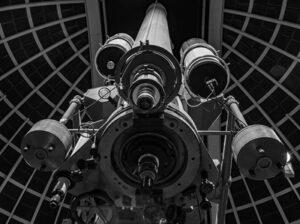
Griffith Observatory is one of the premier public observatories in the world. One of the principal reasons is the presence and regular availability of high-quality public telescopes. Griffith J. Griffith wanted the public to have the opportunity to look through a telescope, which he felt might broaden human perspective. Mounted in the copper-clad dome on the east end of the building is the Zeiss telescope array. This telescope is free to the public every night the Observatory is open and the sky is clear.
The 12-Inch Zeiss Refracting Telescope
Since opening in 1935, more than seven million people have put an eye to Griffith Observatory’s original 12-inch Zeiss refracting telescope. More people have looked through it than any other telescope in the world. Located in the roof-top dome on the building’s east end, the Zeiss telescope is intended mainly for nighttime viewing by the general public, commonly targeting the Moon, planets, and brightest showpiece objects of our galaxy. A popular public destination when special celestial events occur, more people viewed Halley’s Comet and comets Hale-Bopp and Hyakutake through the Observatory’s Zeiss telescope than any other telescope on the planet.
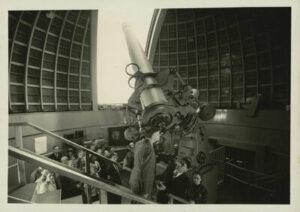
The telescope itself is in excellent condition and was unchanged by the renovation and expansion project. The copper roof of the telescope dome was repaired and restored, and the dome’s drive mechanisms were replaced. The most significant change is the addition of a new exhibit station located in the Hall of the Eye exhibit hall below the telescope dome. The station provides live video and audio feeds from the telescope and allows visitors unable to climb the stairs into the telescope dome to have an observing experience. Most nights, other telescopes also are available on either the roof or front lawn to allow those in wheelchairs to observe directly.
When the night sky is clear, the Zeiss telescope is open from the roof and serves up to 600 visitors per night. One of the Observatory’s experienced telescope demonstrators guides the public in looking through the eyepiece of the 12-inch Zeiss refractor (so-called because its light is collected and focused by a 12-inch diameter glass lens at the front of the 16-foot-long telescope tube). The main telescope tube carries a smaller 9-inch refracting telescope piggyback, which permits two different views of a single object, as appropriate.
The telescope sits on a tilted mounting (an equatorial mount) aligned with the Earth’s axis, and it is slowly turned by a motor to compensate for the Earth’s rotation so that objects remain centered in view for as long as is desired. Counterweights precisely balance the telescope so that the Telescope Demonstrator can easily move the instrument by hand in spite of its 9,000-pound weight. The unique design of construction by Zeiss also counteracts the bending of the telescope due to gravity with counterweighted levers in the telescope’s tube and mounting. Such a system is said to be “stress compensated.”
The genesis of Griffith Observatory’s public telescope occurred when Griffith J. Griffith was invited to visit to Mount Wilson Observatory, then home to the world’s largest operating telescope, the 60-inch reflector. While there, he was given the opportunity to view a celestial wonder through the telescope. Profoundly moved by the experience, Griffith seized on the idea of constructing a public observatory with a telescope that could be used by all residents of Los Angeles. He specified in his will that the telescope was to be “at least 12-inches in diameter” and “complete in all its details” and was to be located “high and above the Hall of Science.” In 1931, the Griffith Trust ordered the telescope from the Carl Zeiss Company of Jena, Germany; the $14,900 spent on the instrument was the first purchase of material for Griffith Observatory.

2800 East Observatory Road, Los Angeles, CA 90027

Griffith Observatory is Southern California’s gateway to the cosmos! Visitors may look through telescopes, explore exhibits, see live shows in the Samuel Oschin Planetarium, and enjoy spectacular views of Los Angeles and the Hollywood Sign.
All visitors must wear a face mask at all times while inside the Observatory and on the roof. By entering the building, visitors are agreeing to follow this requirement.
Starting November 29, 2021, visitors will also need to show proof of COVID-19 vaccination to enter.
Everyone is Welcome
Griffith Observatory is a free-admission facility located on the south side of Mount Hollywood in Griffith Park. The building and grounds are accessible for all visitors. The building is busiest on weekends, during summer and holiday periods, and at sunset.
Griffith Observatory’s grounds and roads are generally open the same hours as Griffith Park, 5:00 a.m. to 10:30 p.m., every day. Access to Griffith Park is free, though there is paid parking closest to the Observatory. There are public restrooms located next to the Observatory parking lot. Trailheads on Observatory grounds lead to Mount Hollywood, the Greek Theatre area, and Fern Dell.
Daily Programs
Whether you experience the universe in the Samuel Oschin Planetarium, observe the sky through a telescope, explore the exhibits, listen to a talk about the Tesla Coil, or pose with the Hollywood Sign, each day there’s something to engage and inspire you at Griffith Observatory.
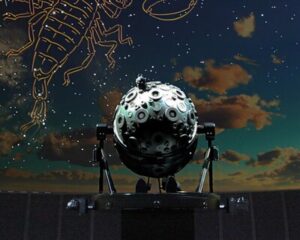
Samuel Oschin Planetarium
Travel to the farthest reaches of the universe and into the microscopic building blocks of life. Live presentations immerse you in the wonder and meaning of the cosmos.
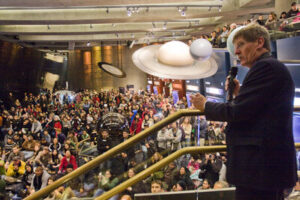
Calendar
Are you looking for latest discoveries about the universe, what leading astronomers are saying, or when Sun is at its highest point each day? We’ve got you covered. Whether our events are on the lawn, in the Leonard Nimoy Event Horizon, or online, we’ll make sure you know what’s up in the cosmos.
Hours
Monday-Wednesday: Closed
Tuesday – Friday: 12:00pm – 10:00pm
Saturday – Sunday: 10:00am – 10:00pm
For additional information, visit the website @
griffithobservatory.org/exhibits

Find more