
TONIGHT- The Hammer Museum
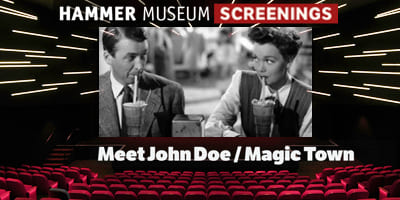
The Hammer Museum present a free screening of
MEET JOHN DOE
U.S., 1941
Director Frank Capra and screenwriter Robert Riskin’s 1941 political fantasy Meet John Doe wasn’t set in the near or distant future but it feels more prophetic by the hour. It’s got it all: a disconnected, alienated (largely white) American working class, fake news, an incipient fascist cabal and, of course, mobs. In Capra and Riskin’s telling, the parting shot of a disgruntled reporter (Barbara Stanwyck)—a manifesto in the form of a suicide note, written by a fictional everyman—inadvertently launches a nationwide political movement after her nervous newspaper finds a patsy to play the everyman (Gary Cooper). Outwardly well-intentioned, the movement is quickly co-opted by corrupt autocrats bent on seizing power. Even Capra and Riskin’s struggle—and ultimate failure—to bring their nihilistic vision to a satisfying resolution seems to resonate with today’s headlines.
35mm, b&w, 129 min. Director: Frank Capra. Screenwriter: Robert Riskin. With: Gary Cooper, Barbara Stanwyck, Edward Arnold.
Preserved by the Stanford Theatre Foundation and UCLA Film & Television Archive.
MAGIC TOWN
U.S., 1947
For his post-war, second take on American populism, screenwriter Robert Riskin leans heavier into the romance than he did in Meet John Doe if only to recast love as the ultimate form of bipartisanship. A Hollywood paean to the pleasures of small town life and the simple grace of being median, Magic Town finds the forces of change— Jane Wyman’s crusading editor—and the forces of stasis—James Stewart’s cynical pollster—locked in flirtatious combat over the fate of Grandview, a pleasant burg that Stewart discovers perfectly reflects the aggregate opinions of the nation as a whole. The media, politicians and all manner of profit-seeking elites are the targets of Riskin’s satire in defense of the common sense folk who inevitably, in Riskin’s view, always end up holding the bag.
35mm, b&w, 103 min. Director: William A. Wellman. Screenwriter: Robert Riskin. With: James Stewart, Jane Wyman, Kent Smith.

The Billy Wilder Theater, home of UCLA Film & Television Archive’s public programs, is among a handful of venues nationwide able to exhibit an entire century’s worth of moving images in their original formats. From the earliest silent films requiring variable speed projection all the way up to cutting-edge digital cinema, the Wilder can accommodate an array of screen technologies.
The theater’s modern design by Michael Maltzan Architecture stylishly interprets cinema’s play of light and movement in real space, and the 285-seat interior features comfortable leather seats with superb sightlines. The theater is made possible by a generous gift from Audrey L. Wilder and named in honor of Mrs. Wilder’s late husband, the legendary screenwriter, director and producer. Born on the outskirts of the Austro-Hungarian empire, Billy Wilder fled Nazi Germany in the 1930s to become a master of Hollywood film language and a shrewd comic observer of the American scene. Among the many classics Wilder co-wrote and directed were Double Indemnity (1944), Sunset Boulevard (1950) and Some Like It Hot (1959).
Please note that food is not permitted inside the theater. There are dining options in the surrounding Westwood Village. You may also opt to bring your own food and eat in the courtyard just outside the theater.
The Hammer Museum champions the art and artists who challenge us to see the world in a new light, to experience the unexpected, to ignite our imaginations, and inspire change.
The Hammer understands that art not only has the power to transport us through aesthetic experience but can also provide significant insight into some of the most pressing cultural, political, and social questions of our time. We share the unique and invaluable perspectives that artists have on the world around us.
A vibrant intellectual and creative nexus, the Hammer is fueled by dynamic exhibitions and programs—including lectures, symposia, film series, readings, and musical performances—that spark meaningful encounters with art and ideas.
And through our unwavering commitment to free admission and free public programs, the Hammer Museum is open for all and FREE FOR GOOD.
Hours
Monday: Closed
Tuesday – Sunday: 11:00am – 6:00pm
For additional information, visit the website @
https://hammer.ucla.edu/

Find more