

OPEN WEDNESDAY – SUNDAY- San Pedro
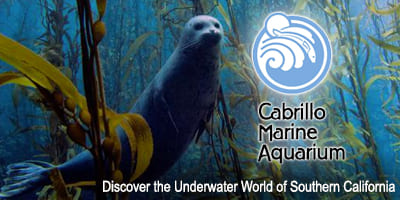
Cabrillo Marine Aquarium welcomes you to come discover the underwater world of Southern California.

Susanne Lawrenz-Miller Exhibit Hall
The Susanne Lawrenz-Miller Exhibit Hall showcases three major environments: Rocky Shores, Sand and Mud, and Open Ocean Ecosystems. Explore interpretative and live exhibits to learn about the many animals and plants that live in each habitat. From worms to whales – all are adapted to protect themselves, find food and reproduce.

Kelp Forests
The richest habitat along our Californian rocky shores is the kelp forest. Giant kelp is the largest and fastest growing of all seaweeds and forms the framework for the kelp forest community. It attracts and influences many other species of animals and plants within the forest. Later, when it tears loose as drift kelp, it provides large quantities of food for animals living on the seashore and ocean bottom.
Kelp bass, giant kelpfish, garibaldi, norris’ top snail, and kelp crabs are all common inhabitants of the kelp forest. Kelp anchors to the rocky bottom with a structure called the holdfast. The holdfast has many crevices and is home to many other animals such as spiny brittlestars and amphipods. The leaf-like kelp blades (also called fronds) provide a large surface area for photosynthesis. On the blades themselves, a bryozoan can grow rapidly and completely cover a kelp blade within 3-4 weeks.
Kelp forests are found along the west coasts of North and South America, the southern tip of Africa and Australia, and islands near Antarctica. Giant kelp grows best in well mixed, cool, clear ocean water. In southern California, giant kelp beds were common until the 1950s. Changes in water conditions and the near extinction of the southern sea otter, which resulted in a population explosion of the purple sea urchin, severely reduced the size and number of local kelp beds for several years. Due to restoration efforts, kelp forests have recovered along Palos Verdes in the last several years.

Mudflats
The mudflat habitat is an enclosed coastal area with fresh and saltwater saturated sediments. Mudflats appear barren but conceal a rich variety of life. Many animals depend on this fragile and threatened habitat. Commercially important fish, such as the California halibut, use this habitat as a nursery ground which provides protection and a rich source of food.
The area surrounding the upper part of the mud is called the saltmarsh and teems with plants. Marsh plants provide shelter and living space for other organisms. The breakdown and decay of these plants produce organic debris which is a rich food source for a variety of invertebrates, like fiddler crabs and amphipods. These animals are an attractive food source for the mudflat’s large bird population, including the willet and snowy egret. Over 100 species of birds reside in or visit southern California mudflats.
The highest zone is dominated by salt grass which can tolerate only the occasional tidal flooding that occurs at this level. The middle zone is characterized by pickleweed which is more tolerant of tidal flooding. The lowest zone teems with eel grass which is one of the few marsh plants that can grow completely underwater.
Visit the mudflat room at the aquarium to learn more about marsh plants and the many animals that depend on this important habitat.

Rocky Shores
The rocky shore is a difficult place to live, yet some of the largest and most diverse populations of marine plants and animals can be found here. Explore how these animals have many different adaptations to protect themselves and find food.
Seaweeds and microscopic plants produce the basic food of the ocean using the sun’s energy. Seaweeds then provide food for such grazers as snails, sea hares and urchins. In the rocky shore, sponges, sea squirts, mussels, fanworms and barnacles filter tiny food particles from the water. Sea anemones and their relatives are hungry predators. These animals, in turn, are eaten by the flamboyant nudibranch slugs and other snails.
The richest habitat along our Californian rocky shores is the kelp forest. Kelp grows up to two feet a day and provides food and shelter for many other plants and animals.
Hunters of the seashore capture their prey in different ways. Sea stars use hundreds of tube feet. Worms and snails may drill or harpoon their prey, while some crabs use powerful crushing claws.
While visiting the touch tank you can experience a variety of rocky shore marine life such as a sea star or a prickly urchin. The touch tank expert will teach you the names and special traits of the marine life as well as answer any of your questions.

Open Ocean

Hours
Monday & Tuesday: Closed
Wednesday – Sunday: 12:00am – 5:00pm
Admission is free but donations are appreciated
For additional information, visit the website @
https://www.cabrillomarineaquarium.org/

Find more