
FRIDAY TO SUNDAY – Culver City
The Wende Museum is an art museum, historical archive of the Cold War, and center for creative community engagement that explores and inspires change. The Wende Museum is open Fridays, Saturdays, and Sundays from 10:00 am – 5:00 pm. Admission is free, and no reservations are required.
ADMISSION IS FREE, NO RESERVATIONS ARE REQUIRED.
Public Tours
The Wende Museum offers free, guided tours of the museum and exhibitions on Saturdays and Sundays at 1 p.m.
Private Tours
Private, docent-led tours of the Wende Museum are available upon request. Contact tours@wendemuseum.org for more information.
The Wende Museum remains committed to protecting the health and safety of our visitors and staff.
Per the mandate of the Los Angeles County Department of Public Health on March 4, 2022, the Wende Museum strongly encourages visitors to wear masks while visiting the indoor galleries regardless of vaccination status. While proof of vaccination is not required for general visitation and outdoors programs, it is required for individuals attending indoor events.
- Visitors are asked to maintain a physical distance of six feet from staff and other visitors.
- Please do not visit if you have symptoms of COVID-19, including fever, cough, shortness of breath, sore throat, loss of taste or smell, chills, head or muscle aches, nausea, diarrhea, or vomiting. Anyone exhibiting signs of illness will not be permitted entry.
- Please do not visit if you have had a positive COVID-19 test within the past two weeks, or if you have been advised to self-quarantine by a medical professional.
- Those in recent contact with anyone who has tested positive for COVID-19 within the past two weeks are asked to visit at a later date.
- Children must be supervised by an adult.
If you have any questions, please email info@wendemuseum.org or call (310) 216-1600.
CURRENT EXHIBITIONS
The Medium is the Message: Flags and Banners

Originally used to identify soldiers in battle and ships in international waters, flags have represented large geographic territories since the rise of the nation-state beginning in the late eighteenth century. Like monuments and national anthems, they intend to create a sense of identity-based on a shared past, present, and future.
Like many other governments, the communist countries of the twentieth century produced an abundance of flags and banners. They were omnipresent at military parades, sports events, and public gatherings. Apart from national flags, many organizations produced their own richly decorated flags and banners. The Wende Museum holds over 2,000 of these ornamental textiles in its collection.
Martin Roemers: Relics of the Cold War
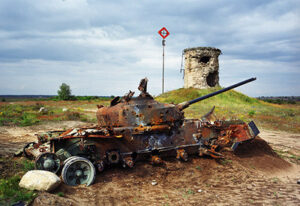
During an eleven-year period, from 1998 through 2009, Dutch photographer Martin Roemers photographed the structural and topographic remnants of the Cold War in both the East and West. His research took him to Russia, Poland, Czech Republic, Ukraine, Latvia, Lithuania, Great Britain, Netherlands, Belgium, and Germany, where he documented underground tunnels, abandoned army bases, military training areas, rotting tanks, and destroyed monuments.
Light–guard–house: Installation by Farrah Karapetian

The 20-square-foot aluminum guardhouse that sat outside the ADN headquarters in East Berlin from 1971–92 is both an artifact of an atmosphere of mistrust and representative of past and current political protectionism. Artist Farrah Karapetian will turn this structure into a lighthouse, changing a gesture of suspicion into a gesture of welcome. The windows of the guardhouse will be tinted in a rainbow gradient encompassing all of the colors potentially included in national flags. Over the course of Wende’s concurrent exhibition, The Medium is the Message: Flags and Banners, Karapetian will engage with the public about experiences they have had as migrants. As the stories accumulate and become available on the museum’s website, the light inside the lighthouse will pause at the various colors associated with the flags of the respective national borders crossed. Rather than the finality of immigration, the artist’s focus is the prevalence of migration, asking visitors: What experiences of welcome or mistrust have occurred as you have moved internationally? How have they colored your life in their wake?

10808 Culver Blvd., Culver City, CA 90230

The Wende is an art museum, historical archive of the Cold War, and center for creative community engagement that explores and inspires change.
The Wende reaches beyond the conventional walls of a museum and places equal value on an international scholarship, community engagement, digital access, and wide-ranging experimentation.
Wende is a German word meaning “turning point” or “change” that has come to describe the transformative period around the fall of the Berlin Wall. Founded in 2002, the Wende Museum holds an unparalleled collection of art and artifacts from the Cold War era, which serves as a foundation for programs that illuminate political and cultural changes of the past, offer opportunities to make sense of a changing present, and inspire active participation in personal and social change for a better future.
The Wende fulfills its mission of exploring and inspiring change through
- collecting, preserving, and providing open access to artwork, artifacts, archives, films, and personal histories from the sphere touched by socialism during the Cold War era (1945– 1991);
- promoting rigorous scholarship, educating students, and stimulating general interest through lectures, symposia, publications, and providing access to digitized collections;
- presenting experimental exhibitions and interdisciplinary programming inspired by the collection;
- facilitating creative collaborations with contemporary artists and designers;
- partnering with other nonprofit organizations; and
- providing community services such as wellness programs, opportunities for civic engagement, and family-friendly activities.
Core Strengths
The Wende Museum’s collection and intellectual activities have achieved notable strength in four areas of specialization: German Democratic Republic; Wende Moments; Personal Histories and Everyday Life; and Public and Private Interaction.
Hours
Monday – Thursday: Closed
Friday – Sunday: 10:00am – 5:00pm
For additional information, visit the website @
www.wendemuseum.org

Find more